Calm living isn't the absence of chaos; it's the presence of clarity.
If you've ever searched for how to feel calm when everything feels like too much, you already know that calm isn't something that arrives once life slows down. Life rarely slows down on its own. Calm is something you build, a quiet confidence that you can meet whatever comes without losing yourself in the noise.
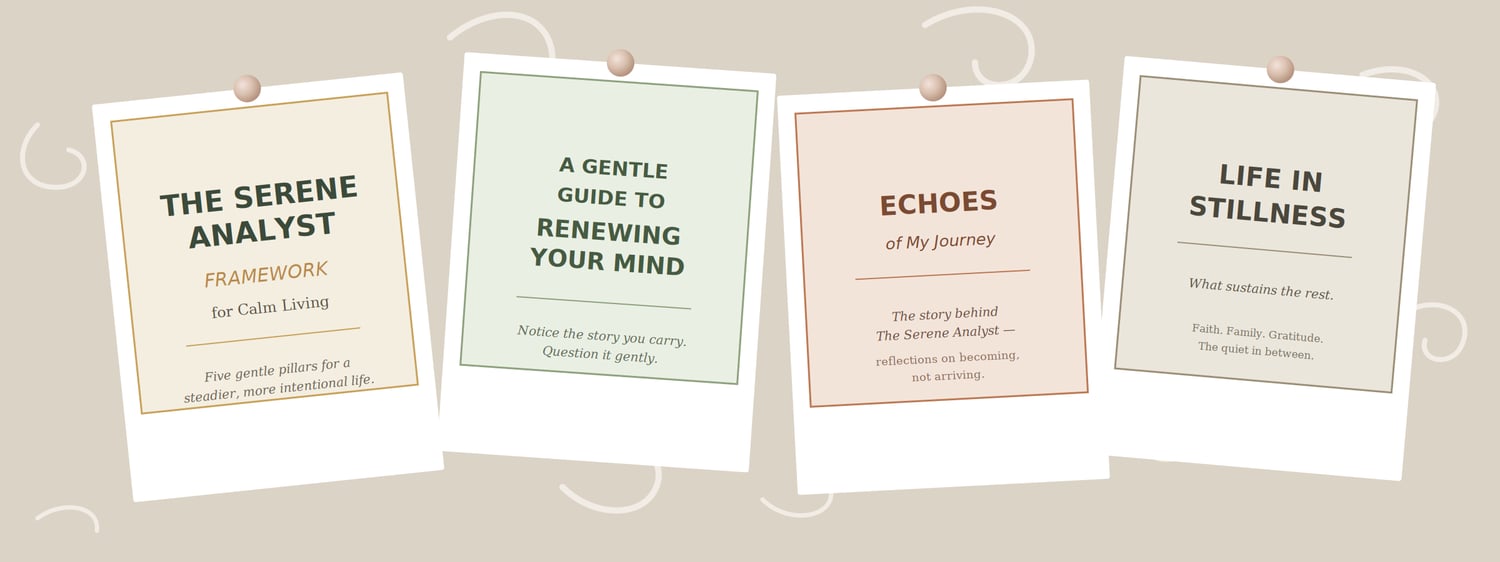
This is the foundation of The Serene Analyst: a structured, repeatable framework for intentional living that prioritises gentleness, depth, and clarity over hustle, urgency, and performance. It's not a set of rules. It's a way of being, and like any way of being, it can be practised, returned to, and rebuilt on the days it slips.
Below are the five pillars that make up this framework, along with reflection prompts you can use to bring each one into your own life.
New to TSA? The Serene Analyst: Where Calm Meets Clarity is a good place to start: it maps out the full site and where this framework fits within it.
The Five Pillars of Calm Living
1. Clarity Before Action
Calm begins with understanding: not rushing, not reacting, just seeing clearly before you move.
This is one of the most searched aspects of emotional regulation: how do you stop reacting on autopilot? The answer isn't willpower. It's a pause long enough to ask what's actually happening, underneath the noise.
What this looks like:
- Pausing before responding, even for ten seconds
- Naming what you feel, specifically, rather than generally ("frustrated" instead of "bad")
- Identifying what actually matters in the moment
- Separating noise: other people's urgency, old fears, assumptions, from what's true
Why it matters: Clarity reduces emotional friction. When you see clearly, you move wisely instead of reactively. Most regret doesn't come from bad decisions; it comes from decisions made before there was enough clarity to make them well.
I remember a season when every email felt like an emergency. I'd reply within minutes, heart already racing before I'd finished reading the first line. It wasn't until I started pausing, just long enough to ask, "Is this actually urgent, or does it just feel urgent?" that I noticed how much of my day had been shaped by other people's pace instead of my own judgment. The pause didn't slow me down. It gave me somewhere to stand before I moved.
Related reading: Pause Before You React: The Space Between Stimulus and Response
2. Soft Strength
Calm living is not passive. It's strength expressed gently, and this is often the hardest pillar for people to believe is possible, because most of us were taught that strength and softness are opposites.
They aren't.
Soft strength means:
- Choosing steadiness over urgency, even when everyone around you is moving fast
- Holding boundaries without hostility
- Being firm without being hard
- Allowing yourself to be human, including the moments you don't get it right
Why it matters: Soft strength protects your peace without disconnecting you from the people around you. It's the difference between a boundary that closes a door and a boundary that simply says this far, gently, and no further. This is often where people start searching for how to set boundaries without guilt, and the honest answer is: boundaries feel uncomfortable at first because they're unfamiliar, not because they're wrong.
There was a version of me who said yes to almost everything, mostly to avoid the discomfort of disappointing someone. The shift wasn't dramatic; it was one small "I can't take that on right now" said out loud, without an apology attached. Nothing fell apart. The relationship stayed intact. What changed was that I stopped mistaking my own exhaustion for generosity.
Related reading: Boundaries at Work Examples You'll Recognise (and How to Set Them)
3. Intentional Pace
Your pace shapes your experience of everything: your relationships, your work, your own thoughts. Calm living requires choosing a rhythm that honours your nervous system rather than one dictated by everyone else's urgency.
Intentional pace looks like:
- Slowing down deliberately when your mind starts to race
- Creating breathing room in your schedule, not just your calendar's empty slots
- Doing one thing at a time, fully, instead of five things partially
- Letting go of performative productivity, busyness as identity rather than necessity
Why it matters: A slower, more intentional pace creates space for clarity, creativity, and emotional regulation to actually happen. You cannot think clearly at a sprint. Nervous systems regulate in stillness, not in motion, which is part of why so many people feel calmer after a walk than after a to-do list.
For a long time, my calendar looked full, and my mind felt empty, stretched thin across too many things done partially instead of a few things done fully. The change came from something almost embarrassingly simple: leaving fifteen minutes of nothing between tasks. Not fifteen minutes to catch up. Fifteen minutes to just be between one thing and the next. That small margin was where my thinking actually started to clear.
Related reading: Rest and Rhythm: Why We Weren't Meant to Live at Full Speed All the Time
4. Honest Inner Dialogue
Calm living is impossible without truth, not harsh truth, but gentle honesty. The version of self-talk that tells you what's actually happening instead of what you think you should be feeling.
This pillar includes:
- Acknowledging your needs instead of minimising them
- Naming your fears without shame
- Speaking to yourself with the same compassion you'd offer a friend
- Replacing self-criticism with curiosity, asking why instead of what's wrong with me
Why it matters: Honesty grounds you. Compassion sustains you. Most people who struggle with negative self-talk aren't lacking discipline; they're lacking a gentler internal voice to replace the critical one with. This pillar is about building that voice, one honest conversation with yourself at a time.
I used to narrate my own mistakes the way a harsh critic would, quick to judge, quicker to move on before I'd actually understood what happened. Writing became the place where that started to soften. On the page, I could ask myself why instead of what's wrong with you, and slowly, that question became a habit that followed me off the page too.
For a step-by-step process to work through this, see [A Gentle Guide to Renewing Your Mind].
Related reading: The Stories We Mistake for Truth
5. Meaningful Micro-Practices
Calm is built in small moments, not grand gestures. This is the pillar people underestimate most, because it doesn't look like transformation; it looks like almost nothing at all. That's exactly why it works.
Examples:
- A three-minute grounding pause between tasks
- A short reflective journal entry, even three sentences
- Choosing silence over noise, on purpose, for a few minutes
- Stepping outside for fresh air before responding to something difficult
- Drinking water slowly and mindfully, as an anchor back into your body
Why it matters: Micro-practices create consistency, and consistency creates calm. You don't need an hour of stillness a day. You need small, repeatable moments that remind your nervous system it's safe to slow down.
On the hardest days, the ones where a full reset feels impossible, it's never been the big rituals that brought me back; it's been one glass of water, drunk slowly, standing still at the kitchen counter for two minutes. Nothing about the day changed. But something in me settled enough to face the rest of it.
Related reading: 7 Days of Gentle Reflection: a free, day-by-day companion for building exactly this kind of small, repeatable practice.
How the Framework Works Together
These pillars aren't steps to complete in order. They're a cycle, a gentle loop that keeps you anchored, even when life doesn't cooperate.
Clarity informs soft strength. Soft strength supports an intentional pace. Intentional pace makes honest inner dialogue possible. Honest dialogue guides meaningful micro-practices. And micro-practices, in turn, reinforce clarity again.
You won't move through this perfectly. Some weeks you'll live entirely from pillar five, just trying to get through the day one grounding pause at a time. That's not failure, that's the framework doing exactly what it's meant to do.
Reflection Prompts
Use these to integrate the framework into your daily life:
- Where in my life do I need clarity before action?
- What does soft strength look like for me this week?
- Which part of my pace feels rushed or pressured right now?
- What truth am I avoiding that needs gentle attention?
- Which micro-practice can I commit to today?
Sitting with these questions is often where clarity begins. Find Yourself Beneath What You Carry was written to walk alongside you for the fuller journey, one page at a time.
Related resource: Find Yourself Beneath What You Carry: a gentle, guided path to carry this framework further, one step at a time.
If you'd like support working through these questions with more structure and depth, TSA's Clarity Sessions and Guided Journaling Sessions are built around this exact framework.
"Calm isn't something you arrive at. It's something you return to; gently, again and again, for as long as it takes."
— The Serene Analyst