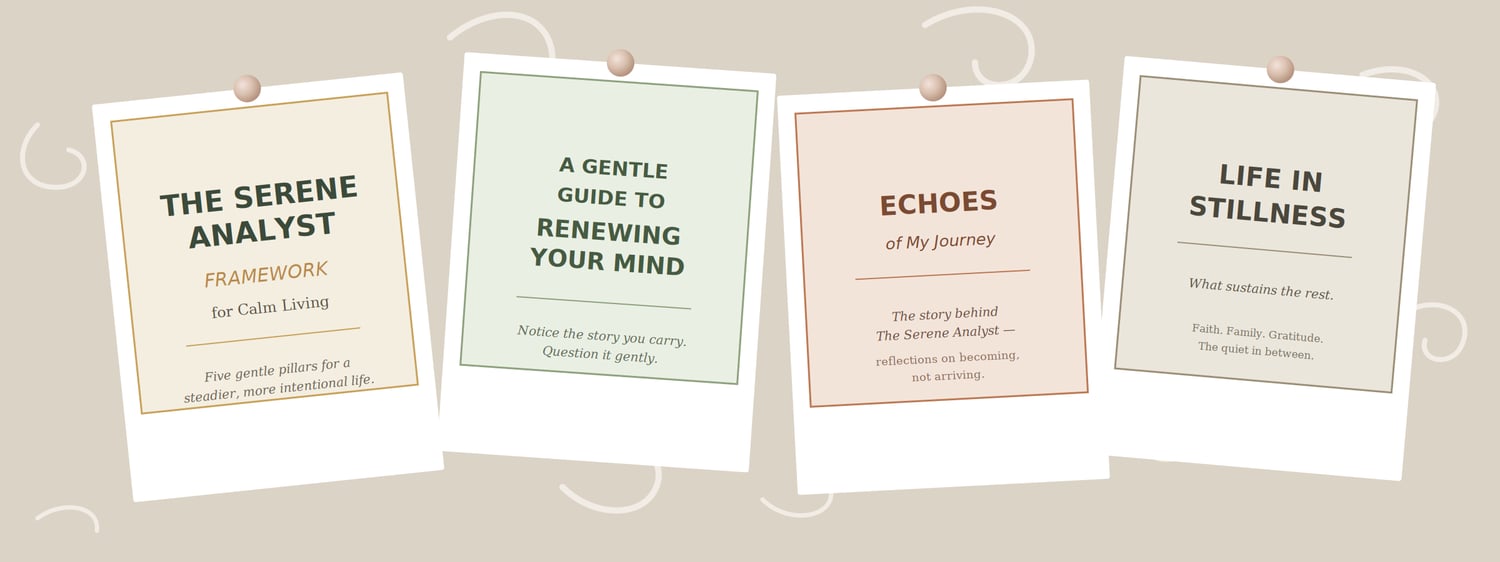
Living a life of stillness
Every pillar at The Serene Analyst asks something of you: pause before reacting, think before deciding, reflect before moving on. This one is the foundation on which the others stand.
Stillness isn't a single thing, and it isn't only about rest. It's what's underneath: the anchors that hold steady when life doesn't, the practices that keep you connected to yourself, and the places where all of that actually gets lived out. Without it, clarity fades under constant motion and growth becomes another form of striving.
If you've been searching for how to live with more stillness in a full, demanding life, here's what that actually looks like in practice: not as an idea, but as something built from a few concrete pieces.
Why Stillness Gets Crowded Out
Stillness rarely disappears all at once. It gets crowded out: one commitment, one notification, one unexamined day at a time, until the anchors, practices, and places that hold it start to feel optional.
We're taught to measure a day by what it produced, which makes anything that doesn't look productive feel like falling behind, whether that's rest, reflection, or simply being present with someone instead of getting something done. Stillness gets pushed to "later," and later rarely comes on its own.
Stillness is not laziness. It is not the absence of ambition, care, or responsibility. It's the discipline of staying rooted and present even while everything around you moves fast, which is exactly why it takes practice, not just permission.
What Stillness Means at TSA
For me, stillness isn't abstract. It has a shape: things that root it, things I intentionally do, and places where it's actually experienced.
Anchors: The things that root us
Faith: My faith isn't a separate compartment from the rest of this work; it's often the ground underneath it. The quiet, unglamorous parts of faith, prayer that doesn't feel dramatic, trust that has to be renewed daily rather than settled once, have taught me more about stillness than almost anything else. When life is uncertain, faith has been the place I return to before I have any clarity about what comes next.
Gratitude: Gratitude is what keeps stillness from becoming passive. Not the performative kind, but the quieter practice of noticing what's already here before reaching for what's next. It's an anchor because it pulls attention back to the present, again and again, whenever it drifts toward what's missing.
Practices: The things we intentionally do
Reflection: Stillness isn't the absence of thought; it's thought given room to settle. Reflection is how I process rather than just accumulate experience: writing, sitting with a question instead of rushing to answer it, letting understanding arrive slowly instead of forcing it.
Rest: Rest here means more than sleep. It's permission to stop producing, even briefly, without needing to earn it first. It's often the hardest practice on this list because it runs directly against the instinct to always be doing something useful.
Presence: Presence is choosing to be fully where you are, rather than mentally several steps ahead or behind. It's the practice that makes the other two possible; you can't reflect or rest if part of you is always somewhere else.
Places: Where stillness is experienced
Relationships: The rhythms of being a wife and mother don't leave much room for stillness in the traditional sense; quiet is rare and often brief. But it's inside those ordinary, unremarkable moments with the people closest to me that I've learned stillness isn't about silence. It's about presence, even in the middle of noise.
Nature: There's a kind of stillness that only arrives outdoors: unhurried, wordless, asking nothing of you. Even a few minutes outside can do what an hour indoors trying to relax often can't.
Creativity: Writing and any act of making is where stillness and expression meet for me. It's not always calm in the moment, but it's where the noise of a full mind finally has somewhere to go.
A Simple Way to Begin
You don't need a full ritual to practice stillness. Start with one of these for a week; one from each tier:
- An anchor: Name one thing you're grateful for, specifically, before you go to sleep.
- A practice: Sit in silence for two minutes before you open your laptop in the morning, not to rest, just to arrive.
- A place: Spend five unhurried minutes outside, or with someone you love, without your phone nearby.
Small and repeatable beats big and occasional. Stillness isn't built in a retreat weekend; it's built in the parts of your week that already exist.
Reflection Prompts
- Which anchor, faith or gratitude do I lean on most, and which have I been neglecting?
- Where in my week do reflection, rest, or presence already show up, even briefly, without me having earned it first?
- Which place, relationships, nature, or creativity brings me back to myself fastest?
- What would it look like to treat stillness as foundational rather than optional this week?
- What am I still carrying that stillness might help me finally set down?
Sitting with these questions is often where clarity begins. A Gentle Return to Clarity was written to walk alongside you for the fuller journey, one page at a time.
Related resource: A Gentle Return to Clarity: a gentle, guided path to carry this framework further, one step at a time.
Where to Go From Here
Stillness and reflection tend to walk together; if this resonated, Echoes of My Journey holds the seasons and turning points that stillness often makes visible in the first place.
And if you're new to TSA altogether, The Serene Analyst: Where Calm Meets Clarity is the best place to start.
If you're craving more structured space to slow down and reflect, TSA's Guided Journaling Sessions and Clarity Sessions were built to hold exactly that kind of stillness.